
Bookmaker Evaluation: Stripping Promotional Noise from Real Value
Deciding where to bet on horse racing is the single most consequential choice you make as a punter — more important than the horse you back, the race you target, or the stake you set. I learned this the hard way. For my first three years of betting, I placed every wager with whichever bookmaker happened to be open on my phone, never checking whether a rival was offering 11/1 on the same selection I was taking at 8/1. Over the course of a flat season, that indifference cost me hundreds of pounds in lost value. It was not a strategy problem. It was a bookmaker problem.
The UK horse racing betting market generates £766.7 million in gross gambling yield from remote wagering alone, according to the Gambling Commission's latest industry statistics. That figure represents the bookmakers' cut — the margin extracted from punters like you and me across every race, every meeting, every festival. Meanwhile, attendance at British racecourses climbed to 5.031 million in 2025, the first time that figure has cleared five million since 2019. The sport is very much alive, and so is the money flowing through it.
Yet the landscape punters navigate today looks nothing like the one I entered a decade ago. Affordability checks now gate access to your own funds. Best Odds Guaranteed policies vary wildly between operators. Mobile apps have replaced the betting ring as the primary arena for placing wagers. And the gap between a sharp bookmaker and a mediocre one — in odds quality, streaming access, racecard depth, and cash-out flexibility — has never been wider.
This guide strips away the promotional noise that dominates the first page of search results. No ranked lists of "best bookmakers." No affiliate links dressed up as editorial. Instead, I am going to walk you through the criteria that actually matter when choosing where to bet, the mechanics behind odds and bet types, the regulatory forces reshaping the industry, and the data points every serious racing punter should have at their fingertips. Whether you are placing your first each-way at Cheltenham or grinding out value on a midweek all-weather card, the information here is designed to sharpen every decision you make.
Each-Way Inspector
The Numbers and Choices That Shape Your Racing Returns
- Best Odds Guaranteed adds 2-5% to long-term returns — it is the single most impactful feature to check before opening an account with any bookmaker.
- Affordability checks now trigger at £150 in net monthly deposits, affecting 23.7% of punters; keep your documentation ready to avoid account disruption.
- Mobile devices account for 43% of all bets placed, rising to 76% among under-25s — app quality directly impacts your ability to act on prices and stream races.
- Total betting turnover on British racing has dropped 10.3% since 2023, meaning tighter margins and less inefficiency in the market for value hunters.
- Each-way terms shift with field size, and the difference between 1/4 and 1/5 place fractions can swing a payout by 25% or more on the same selection.
The UK Horse Racing Betting Market in Numbers
I remember sitting at Newbury on a grey February afternoon in 2017, watching a twelve-runner novice hurdle go off in front of maybe two thousand people. The betting ring had four layers, one of whom looked half-asleep. Fast forward to the same fixture last year, and the grandstand was buzzing, the bars were full, and I could not get a signal strong enough to place a bet on my phone because so many people were doing the same thing. That anecdote captures the broader trend in British racing: the sport's live audience is bouncing back, even as the betting economy underpinning it shifts in ways that demand attention.
£766.7 million — the gross gambling yield generated by remote horse racing betting in the UK between April 2024 and March 2025.
That figure sits within a wider online gambling sector that now produces £7.8 billion in GGY annually, representing 46% of the entire UK gambling market. Horse racing's share is smaller than football's, but its per-event betting intensity remains unmatched — no other sport runs 80-plus fixtures a week across 59 racecourses, each generating its own betting market. Of those 59 tracks, 19 host flat racing exclusively, 24 are dedicated jump venues, and 16 run both codes.
5.031 million — total attendance at British racecourses in 2025, the first time the figure has exceeded five million since 2019.
Racecourse attendance grew 4.8% year on year, with Premier fixtures up 5.3% and everyday Core fixtures up 4.4%. That recovery matters for punters because it reflects renewed commercial confidence — racecourses investing in facilities, prize money climbing, and broadcasters paying for coverage that translates into more streaming options on your betting app.
59 British racecourses — 19 flat-only, 24 jump-only, 16 dual-purpose. From Aintree and Ascot to Wolverhampton and York, the UK has the densest network of racing venues anywhere in the world.

Participation follows a sharp seasonal curve. During the festival window from April through July — when Cheltenham, Aintree, the Guineas, Epsom and Royal Ascot all land — 7% of British adults place a bet on horse racing. By the quieter months between July and October, that figure drops to 4%. Andrew Rhodes, Chief Executive of the UK Gambling Commission, framed this pattern clearly: racing's GGY tracks along with the results of marquee events, and the recent statistics point to a return to the previous norm rather than any decline. The UK sports betting market as a whole generates £2.48 billion in annual GGY, with projections suggesting the sector could reach roughly $21.3 billion in revenue by 2030. Horse racing's slice of that pie depends on how effectively it holds its audience through the quieter months — and how well bookmakers serve the punters who stay loyal year-round.
Each-Way Inspector
What Makes a Horse Racing Bookmaker Worth Using
A few years back, I was watching a midweek jumps card at Wetherby and spotted a horse I liked at 9/1 on one app. Out of habit, I checked two others. One had 8/1. The other had 11/1. Same horse, same race, same moment — a 37.5% difference in potential return. That experience cemented a rule I now follow without exception: never bet without checking at least two sets of odds. But odds are just one dimension of what separates a bookmaker worth using from one that quietly costs you money.
The starting point is non-negotiable: a valid UK Gambling Commission licence. Every operator legally offering betting services to UK residents must hold one, and the UKGC maintains a public register where you can verify any bookmaker in under a minute. Operating without a licence is a criminal offence, and betting with an unlicensed operator means forfeiting every consumer protection the regulated market provides — dispute resolution, fund segregation, self-exclusion tools, all gone.
UKGC licence check: Visit the Gambling Commission's public register, search by operator name, and confirm the licence status reads "active." If a bookmaker is not listed, do not deposit funds.
Beyond the licence, here is what I evaluate when deciding whether a bookmaker earns a place on my shortlist:
| Criterion | What to Look For | Why It Matters |
|---|---|---|
| Odds coverage | Early prices on UK and Irish racing from the morning, competitive SP | Wider coverage means you are not forced into SP on races where early value existed |
| Live streaming | UK and Irish racing feeds with minimal delay, no funded-account gating for all races | Watching the race you have backed is not a luxury — it informs in-play decisions and cash-out timing |
| Best Odds Guaranteed | BOG on all UK and Irish races, not just selected meetings | A consistent BOG policy adds 2-5% to long-term returns on early-price bets |
| Cash out | Partial cash-out options, available during races, fair pricing without excessive margin | Flexibility to manage risk mid-race, particularly on accumulators and ante-post wagers |
| Racecard depth | Integrated form, trainer/jockey stats, going preferences, speed ratings | Racecard quality determines whether you need to leave the app to research a selection |
Mobile experience deserves its own weight in this assessment. A growing share of punters — nearly half, skewing heavily toward younger demographics — now bet exclusively from their phones. An app that stutters when you try to place a bet thirty seconds before the off, or one that buries the racecard behind three menu taps, is not just inconvenient — it is operationally inadequate. I have missed bets because of slow-loading apps, and each time it happened I shifted my activity to a competitor within the week.
One criterion that rarely appears in bookmaker reviews but matters enormously is market breadth on smaller meetings. Most operators price up the Cheltenham Gold Cup. Fewer offer early prices on a Monday card at Plumpton. If you bet regularly rather than just at festivals, the bookmaker that prices twenty meetings a week is more valuable to you than the one that prices ten with flashier graphics.
Account restrictions are the elephant in the room. Successful punters — those who consistently take early prices and beat the SP — often find their stakes limited or their accounts closed entirely. This is legal, and it is widespread. No bookmaker advertises it, but it shapes the landscape profoundly. Maintaining accounts with multiple operators is not greed; it is a practical necessity for anyone who bets with any degree of seriousness.
How Horse Racing Odds Work and Why They Vary Between Bookmakers
The first time someone showed me a racecard full of fractional odds — 7/2, 11/4, 100/30 — I genuinely thought I needed a maths degree to figure out what I stood to win. I did not. The principle behind every set of odds is identical: they tell you how much profit you collect relative to your stake if the horse wins. Once that clicks, the rest is detail.
Fractional odds dominate UK racing. A price of 7/2 means that for every £2 you stake, you receive £7 in profit — plus your original £2 back. So a £10 bet at 7/2 returns £45: £35 profit and £10 stake.
Worked example: £10 at 7/2
| Element | Calculation | Amount |
|---|---|---|
| Stake | -- | £10.00 |
| Profit | £10 x (7/2) | £35.00 |
| Total return | Stake + Profit | £45.00 |
Decimal odds express the same thing differently. The 7/2 fractional price converts to 4.50 in decimal form — multiply your stake by 4.50 and you get the total return including stake. Neither format is "better"; fractional is traditional in UK racing, while decimal is standard on exchanges and increasingly offered as a toggle in bookmaker apps.
SP (Starting Price) — the official odds at the moment the race begins, determined by on-course bookmakers. If you do not take an early fixed price, your bet settles at SP.
Early prices — fixed odds offered by bookmakers from the morning of the race (sometimes earlier for big events). Locking in an early price protects you if the horse shortens before the off.
Why do odds differ between bookmakers? Because each operator sets its own market based on liability, customer activity, and commercial strategy. The mechanism behind this is the overround — also called the "book percentage" — which represents the bookmaker's built-in margin.
Overround — the total implied probability of all runners in a race, as priced by a bookmaker. A fair book would total 100%. In practice, it totals 110-130%, with the excess being the bookmaker's theoretical profit margin.

A competitive bookmaker keeps the overround tight — closer to 110% on major races. A less competitive one might run at 125% or higher, meaning you are paying more for every bet you place. Over hundreds of bets, that margin gap compounds into a significant difference in your bottom line.
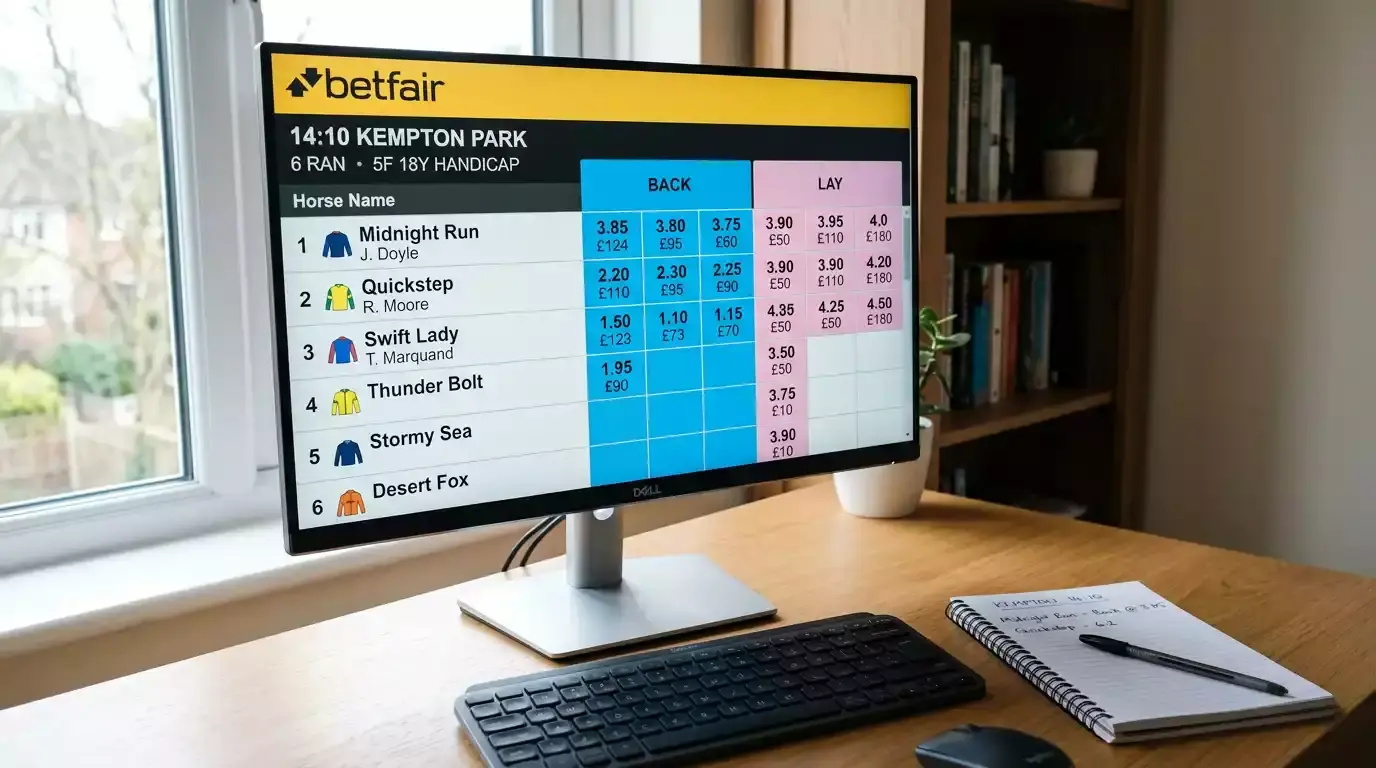
Betting exchanges operate on a fundamentally different model. Instead of betting against a bookmaker, you bet against other punters, with the exchange taking a commission (typically 2-5%) on winning bets rather than building a margin into the odds. Exchange prices often represent the truest market assessment of a horse's chance, which is why professional punters use them as a benchmark even when placing bets elsewhere. For a deeper exploration of how odds are constructed, the maths behind implied probability, and how to spot value in a market, I have written a full breakdown of horse racing odds that goes well beyond the basics covered here.
Welcome Offers and Best Odds Guaranteed: Where the Real Value Sits
I will be blunt: most welcome offers in horse racing betting are designed to look generous while being anything but. I have signed up to dozens of bookmaker accounts over the years, and the pattern is consistent — a headline number that grabs attention, attached to wagering requirements that quietly claw back most of the value. The real edge for racing punters sits not in sign-up bonuses but in a feature most casual bettors overlook entirely: Best Odds Guaranteed.
BOG works like this. You back a horse at, say, 10/1 in the morning. By post time, the market has moved and the Starting Price is 14/1. With BOG, the bookmaker pays you at 14/1 — the higher price. Your £10 bet returns £150 instead of £110. No action required on your part; the adjustment is automatic.
BOG scenario: took 10/1, SP drifts to 14/1
| Scenario | Odds | £10 Stake Return |
|---|---|---|
| Without BOG | 10/1 (your fixed price) | £110 |
| With BOG | 14/1 (SP, the higher price) | £150 |
| Difference | -- | +£40 |
Over a full season of regular betting, BOG alone can add 2-5% to your returns — a figure that dwarfs most welcome offers once you strip out the strings attached. The catch is that not every bookmaker applies BOG universally. Some restrict it to UK races only, excluding Irish fixtures. Others cap the maximum payout boost. A few limit BOG to specific meeting tiers or time windows. Before you celebrate a "free" upgrade in odds, read the terms.
Now, about those welcome offers. They typically fall into a few categories: free bets credited after your first wager, deposit matches with rollover requirements, or risk-free first bets where losses are refunded as bonus funds. The critical number is always the wagering requirement — how many times you must bet through the bonus before withdrawing. A £30 free bet with a 6x wagering requirement at minimum odds of 1/2 is not worth £30. It is worth whatever survives the churn, which is usually a fraction of the headline figure.
Do
- Read the full terms before depositing — focus on wagering multiples, minimum odds, and time limits
- Use free bets on selections with higher odds to maximise expected return
- Compare the effective value of offers rather than the headline number
- Check whether BOG applies to your free bet selections — it often does not
Don't
- Chase a welcome bonus by depositing more than you planned to bet
- Assume "risk-free" means zero cost — refunds usually come as non-withdrawable bonus credit
- Ignore the expiry window; most offers void within 7-30 days
- Treat welcome offers as a long-term strategy — they are a one-time event per operator
Wagering requirements warning: A "£50 free bet" with a 5x rollover at minimum odds of 1/2 requires £250 in qualifying bets before any profit becomes withdrawable. Calculate the true cost before committing.
One fact that surprises new punters: your winnings from horse racing bets in the UK are entirely tax-free. The 15% betting duty is paid by the operator, not the customer. This has been the case since 2001, and it remains unchanged even as Remote Gaming Duty for casino products rises from 21% to 40% in April 2026. Horse racing betting specifically was exempted from the latest budget tax increases — a deliberate policy decision that reflects the sport's economic relationship with the Treasury through the levy system. For a comprehensive breakdown of every promotional format — including seasonal offers, enhanced places, and loyalty schemes — the guide to horse racing free bets and promotions covers what this overview cannot.
Horse Racing Bet Types: From Singles to System Wagers
When I started backing horses, I placed singles and nothing else. Win bets, every time. It took an older punter at Kempton to point out that I was leaving money on the table — not by ignoring exotic multiples, but by not understanding when an each-way bet offered better expected value than a straight win. That conversation changed how I approached every race with eight or more runners.
The win bet is the foundation. You pick a horse, you stake your money, and if it finishes first, you collect. Simple, clean, and the lowest-margin bet available because there is no place component for the bookmaker to load. If you are starting out, singles on win bets at decent odds are where you learn the craft without complexity clouding the picture.
Each-way betting is where most racing punters eventually land. An each-way bet is two bets in one: a win bet and a place bet, at equal stakes. If your horse wins, both parts pay out. If it finishes in the places (typically second or third, sometimes further depending on field size), you collect the place portion at a fraction of the win odds. The place fraction and number of places paid depend on the race conditions:
| Number of runners | Places paid | Place fraction |
|---|---|---|
| 2-4 runners | No each-way available | -- |
| 5-7 runners | 1st and 2nd | 1/4 of win odds |
| 8-11 runners | 1st, 2nd and 3rd | 1/5 of win odds |
| 12-15 runners | 1st, 2nd and 3rd | 1/4 of win odds |
| 16+ runners (handicaps) | 1st, 2nd, 3rd and 4th | 1/4 of win odds |
Each-way worked example: £5 each-way at 10/1, 8 runners
Total stake: £10 (£5 win + £5 place). Place terms: 1/5 odds, 3 places.
| Outcome | Win part | Place part (10/1 at 1/5 = 2/1) | Total return |
|---|---|---|---|
| Horse wins | £5 x 10/1 = £50 + £5 stake | £5 x 2/1 = £10 + £5 stake | £70 |
| Horse places (2nd/3rd) | Loses (£0) | £5 x 2/1 = £10 + £5 stake | £15 |
| Horse unplaced | Loses (£0) | Loses (£0) | £0 |

Notice the swing. In a field of 8 runners at 10/1, your each-way place fraction drops to 1/5 — meaning the place part pays only 2/1. In a 16-runner handicap at the same odds, the place fraction rises to 1/4 (paying 5/2) and four places are paid instead of three. This is why each-way value is not a fixed concept; it shifts with every race depending on field size and the place terms on offer.
Accumulator (acca) — a single bet combining selections from two or more races. All selections must win for the bet to pay out. The odds multiply together, creating large potential returns from small stakes, but the probability of winning drops sharply with each added leg.
Forecast — predicting which horses will finish first and second in the correct order (straight forecast) or in either order (reverse forecast). Payouts are determined by a computer calculation based on SP, not fixed odds.
Tricast — predicting the first three finishers in the correct order. High difficulty, high reward. Available in races with eight or more runners.
Lucky 15 — fifteen bets across four selections: four singles, six doubles, four trebles, and one four-fold accumulator. Offers consolation bonuses if only one selection wins, and enhanced returns if all four win.
Yankee — eleven bets across four selections: six doubles, four trebles, and one four-fold accumulator. No singles, so at least two selections must win to generate a return.
System wagers like the Lucky 15 and Yankee have their place, particularly on days when you have strong opinions across multiple races and want coverage without relying on every selection winning. But understand the maths: a Lucky 15 costs fifteen times your unit stake, and the consolation bonuses vary between bookmakers. They are tools for specific situations, not default strategies. For a thorough walkthrough of every bet type — including patent bets, Heinz multiples, and the mechanics behind computer-calculated forecasts — the dedicated horse racing bet types guide covers each one in depth.
Betting on the Go: Mobile Apps and Live Streaming
There is a moment at every racecourse — usually about two minutes before the off — when you see dozens of people staring at their phones, thumbs hovering over a green "Place Bet" button. They are not checking social media. They are placing bets on the same race happening fifty metres in front of them, because the app offers better odds than the on-course bookmakers. That scene captures something fundamental about how betting has shifted: 43% of UK punters now place their wagers on a mobile device, and among the 18-to-24 age group, that figure soars to 76%.
What makes one betting app functionally better than another for horse racing? I have used a dozen in earnest over the past five years, and the differences are not subtle. They cluster around four factors:
| Feature | What separates good from poor |
|---|---|
| Live streaming | Full UK and Irish racing coverage, minimal delay (under 3 seconds), no mandatory funded balance for every feed |
| Cash out | Available during live races, partial cash-out option, transparent pricing without hidden margin adjustments |
| Racecard integration | Form figures, trainer/jockey statistics, going preferences, and speed ratings without leaving the app |
| Push notifications | Customisable alerts for non-runner updates, market movers, and results — not just promotional spam |
76% of 18-to-24-year-old UK bettors place wagers via mobile, compared to 43% across all age groups.

Streaming quality is the single feature I weigh most heavily. Watching a race you have backed is not entertainment — it is information. Cash-out decisions depend on seeing how a race unfolds. A three-second delay on the stream means you are making decisions on stale data, and in a sport where races last between one and four minutes, three seconds is an eternity.
One statistic that reframes the mobile conversation: 95% of online gambling in the UK happens from home. The mobile app is not primarily a tool for betting at the track or in the pub — it is the interface most people use while sitting on their sofa. That makes usability, speed, and information depth even more critical than portability. An app that loads racecards slowly, buries the form guide behind multiple taps, or crashes during peak Festival periods is failing at its primary job.
The gap between the best and worst racing apps is wide enough to affect your bottom line. A good app puts the racecard, odds comparison, streaming, and bet slip within two taps of each other. A poor one forces you to toggle between screens, lose your place, or miss a price movement because the interface could not keep up with your intent. I have written detailed assessments of how the leading horse racing betting apps perform across these criteria, including real-world streaming tests and racecard comparisons.
Finding Value: How Experienced Punters Approach Horse Racing
Here is something no bookmaker will tell you: the total amount wagered on British horse racing has fallen 10.3% since 2023. The market is shrinking, margins are tightening, and the easy value that once existed in poorly priced fields has largely disappeared. Finding an edge now requires more discipline than it did five years ago — and that starts with understanding what "value" actually means in practice.
Value is not about picking winners. It is about identifying horses whose true chance of winning exceeds the probability implied by their odds. A horse priced at 4/1 implies a 20% win probability. If your analysis suggests it wins 28% of the time in these conditions, that is a value bet — regardless of whether this particular horse wins this particular race. Over hundreds of bets, consistently backing value prices produces profit. Backing favourites because they "should win" does not.
Form reading basics: Recent results (last 3-5 runs), distance suitability, going preference (how the horse performs on different ground), course form (some horses thrive at specific tracks), and trainer/jockey combination strike rate. None of these factors works in isolation — form analysis is about finding the convergence.
Going conditions — the state of the ground from firm to heavy — are the single most underappreciated variable in race analysis. A horse that destroyed a field on good-to-firm ground at Newmarket may flounder on soft ground at the same track two weeks later. Checking the going is a 30-second task that eliminates more losing bets than any other single step.
Draw bias matters too, particularly on flat courses. At Chester, for example, low draws hold a measurable advantage in sprint races because of the tight left-handed bends. At Beverley, high draws dominate in large fields. These biases are well-documented and remarkably consistent, yet most casual punters never factor them in.
Five steps before placing any bet
- Check the going report and confirm your selection handles the prevailing conditions
- Review the last three runs — focus on reasons for defeat as much as form figures
- Assess the trainer/jockey booking: is the first-choice jockey on board, or has a switch been made?
- Compare the price across at least two bookmakers and the exchange
- Set your stake before looking at the odds — never let the price dictate how much you bet
Bankroll management is the boundary between punting and gambling. Flat staking — wagering the same fixed amount on every bet, typically 1-2% of your total bankroll — is the approach I recommend to anyone who asks. It is boring, it lacks the adrenaline of lumping on a "certainty," and it works. More aggressive models like the Kelly Criterion exist, but they require accurate probability estimates that most punters, including me on a bad week, do not consistently produce.
Dutching — splitting your stake across two or more horses in the same race to guarantee profit if any of them wins — is a technique worth understanding even if you use it sparingly. It is particularly effective in competitive handicaps where you rate several horses closely but cannot separate them. The maths is straightforward: you allocate stakes proportionally to the odds so that the payout is equal regardless of which selection wins.
I have kept this section deliberately concise because strategy is a subject that demands its own space. The horse racing betting strategy guide covers staking plans, value identification methods, and race-analysis frameworks in the detail they deserve.
The Regulatory Landscape: UKGC, Affordability Checks and What They Mean for You
In early 2025, a friend of mine — a professional who earns well above the national average — tried to deposit £200 into his betting account for the Cheltenham Festival. The transaction was blocked. His bookmaker demanded bank statements, payslips, and proof of source of funds before allowing him to continue betting. He had been a customer for six years with no history of problem gambling. He closed the account that afternoon and told me he was done with regulated bookmakers altogether. He is not alone.
Affordability checks are the most disruptive regulatory change to hit UK horse racing betting in a generation. Introduced by the Gambling Commission as enhanced customer interaction requirements, they trigger when a customer's net deposits exceed certain thresholds. Since February 2025, that trigger point has been lowered to £150 in net monthly deposits — down from £500. Once triggered, operators must conduct financial risk assessments, which can range from automated checks against public data to demands for payslips, bank statements, or tax returns.
Current threshold: Affordability checks can be triggered at £150 in net monthly deposits. This means any punter depositing more than £150 per month across a single operator may face identity and income verification requests.
The numbers tell a stark story. In 2025, 23.7% of surveyed punters reported being subjected to affordability checks — up from 16.6% just two years earlier. Among higher-staking punters, the friction is even more pronounced: a third of high-rollers now admit to placing bets with unlicensed operators to avoid the process. Sean Trivass, Chair of the Horseracing Bettors Forum, put it plainly: affordability checks remain anything but frictionless. That is not an opinion from the margins — it is a statement from the official body representing racing bettors.
522% — the increase in unique traffic to unlicensed betting websites between August 2021 and September 2024, according to the International Federation of Horseracing Authorities.
Meanwhile, traffic to licensed operators grew by just 49% over the same period. The gap is not a coincidence. When regulated betting becomes harder, a segment of the market migrates to operators who ask no questions — and offer no protections. Sixty-one percent of punters say they refuse to provide financial documents, and roughly one in four has considered moving to the black market. The Betting and Gaming Council estimates that 1.5 million UK residents already spend up to £4.3 billion annually on unregulated platforms.
What a UKGC licence guarantees: Segregated player funds (your deposits held separately from the operator's business accounts), access to the Alternative Dispute Resolution scheme, mandatory self-exclusion via GamStop, and regulatory oversight of fair terms. None of these protections exist with unlicensed operators.
Richard Wayman, Director of Racing at the BHA, acknowledged both sides in the authority's 2025 Racing Report: there was much to be pleased about in major meetings performing strongly, but the challenges around a declining horse population and a difficult betting environment remain real. This is the tension at the heart of UK racing regulation — the measures designed to protect vulnerable gamblers are simultaneously driving recreational punters away from the regulated market and reducing the betting revenues that fund the sport itself.
None of this means affordability checks are wrong in principle. Problem gambling affects an estimated 1.4 million people in the UK. The question is whether the current implementation balances protection with proportionality — and right now, the data suggests it does not. As a punter, your practical response is straightforward: keep records of your betting activity, understand the thresholds, and respond promptly to any verification requests to minimise disruption. Closing an account in frustration and moving to an unlicensed operator is the worst possible outcome for everyone involved.
Major Festivals: When the Biggest Betting Action Happens
My annual leave is planned around the racing calendar. That is not a joke — I book March off for Cheltenham, keep the first Saturday in April clear for the Grand National, and June is blocked out from Epsom through Royal Ascot. If that sounds excessive, consider this: festival periods are when the UK's horse racing betting participation doubles from its baseline, jumping from 4% of the adult population to 7%. The betting markets are at their deepest, the media coverage is at its broadest, and the value opportunities — both good and bad — are at their most extreme.
The UK festival calendar
| Festival | When | Code | Signature race |
|---|---|---|---|
| Cheltenham Festival | March | Jump | Gold Cup |
| Grand National | April | Jump | Grand National |
| Epsom Derby | Early June | Flat | The Derby |
| Royal Ascot | Mid-June | Flat | Gold Cup, Queen Anne Stakes |
| Glorious Goodwood | Late July / early August | Flat | Goodwood Cup, Sussex Stakes |
Cheltenham is the beating heart of jump racing. Four days, 28 races, and a peak television audience that hit 1.8 million in 2025 — the highest in four years. The ante-post markets open months in advance, and the volume of analysis available for every race is staggering. For punters, Cheltenham rewards preparation more than any other meeting: the form book narrows the field, the course specialists reveal themselves year after year, and the market moves are dramatic enough to create genuine value if you get in early.

The Grand National is a different beast entirely. Forty runners, four miles and two furlongs, 30 fences. It is the one race of the year when people who never normally bet walk into a bookmaker's or download an app. That influx of casual money distorts the market — favourites are often overbet, and longer-priced horses with genuine claims can drift to bigger odds than their form deserves. If you do your homework, National day is fertile ground.
Royal Ascot brings the flat season to its zenith. Five days of Group-level racing, attended by 5 million television viewers across the broadcast, with viewing figures for the final day up 20% year on year. The quality of competition at Ascot means fields are smaller but the margins between horses are tighter, making each-way betting in the bigger handicaps and place markets in the Group races particularly appealing.
Epsom and Glorious Goodwood round out the major summer fixtures. The Derby is a once-a-year spectacle with its own unique course characteristics — the camber, the hill, the sweeping Tattenham Corner — that catch out horses who lack the balance to handle it. Goodwood, with its undulations and exposed downland track, is equally idiosyncratic. Both reward punters who study course form rather than relying on headline ratings.
The State of British Racing: Prize Money, Attendance and Betting Trends
British racing is a sport of contradictions right now, and understanding those contradictions matters if you are going to bet on it seriously. I have watched this industry for a decade, and I cannot remember a time when the headline numbers looked so good while the underlying structure creaked so loudly. The surface story is one of records and recovery. Beneath it, the foundations are shifting.
£194.7 million — total prize money in British racing for 2025, a record high and a 3.5% increase year on year.
That prize money record matters to punters because it determines the quality of competition. Higher prize money attracts better horses, and better horses produce more competitive fields — which in turn produce more interesting betting markets. Kevin Walsh, Racing Director of the Racecourse Association, described the annual increase of 3.5% as strong investment in the sport and a continued incentive for participants to field horses at British racecourses. The funding structure behind that number is worth knowing: racecourses contribute £103.4 million (53% of the total), the Horserace Betting Levy Board adds £63.2 million, and owners themselves put in £26.8 million.
The HBLB collected a record £109 million in levy payments for 2024-25 — the fourth consecutive year of growth. The levy is funded directly by a percentage of bookmakers' horse racing profits, which creates an economic loop: more betting on racing generates more levy income, which funds more prize money, which attracts more horses and higher-quality competition. That loop, however, is under pressure.
21,728 — the number of horses in training in Britain in 2025, down 2.3% from the previous year. The horse population has been declining at roughly 1.5% annually since 2022.
Fewer horses in training means smaller fields. Average field sizes on the flat dropped from 9.14 runners to 8.90, and over jumps the decline was sharper, from 8.49 to 7.84. Smaller fields reduce the range of betting outcomes and compress the odds, making it harder for punters to find value in less competitive races. Premier flat meetings bucked the trend — average field size there actually grew to 11.02 — but the everyday fixture list is thinning out.
Total betting turnover on British racing fell 4.3% in 2025 and has lost 10.3% cumulatively since 2023. Online betting turnover alone has dropped by £1.6 billion from its 2022 peak. Adjust for inflation and that figure balloons to £3 billion in real terms. The causes are structural — affordability checks are diverting volume to unlicensed operators and discouraging medium-staking punters from engaging at all.
The tension between the sport's commercial health and its betting economy is not going to resolve itself quickly. An open letter signed by 408 racing figures in April 2026, addressed to the Secretary of State, called for a reconsideration of affordability check policies, arguing that the landscape has changed and the unintended consequences of current regulation are becoming unsustainable. Whether that plea translates into policy change remains to be seen.
Understanding the industry's health is not academic — it directly shapes the betting environment you operate in. The questions that follow address the practical decisions every punter faces, from choosing an operator to placing a first bet.
Horse Racing Betting: Frequently Asked Questions
What is the best horse racing betting site in the UK?
There is no single "best" site — the right bookmaker depends on what you prioritise. If you bet primarily on early prices, an operator with comprehensive Best Odds Guaranteed coverage across all UK and Irish racing will serve you better than one with flashier graphics but limited BOG. If live streaming is your priority, test the feed quality before committing funds. The most important universal criterion is a valid UKGC licence, which ensures your deposits are protected and dispute resolution mechanisms are in place. I maintain accounts with multiple operators for exactly this reason: no single bookmaker excels at everything.
How do horse racing odds work?
Odds represent the ratio of profit to stake if your selection wins. Fractional odds of 5/1 mean £5 profit for every £1 staked, plus your stake returned — so a £10 bet returns £60. Decimal odds express the total return as a multiplier: 5/1 fractional equals 6.00 decimal, meaning £10 x 6.00 = £60 total return. The key concept is that odds reflect the bookmaker's assessment of a horse's probability of winning, with a built-in margin (the overround) that ensures the book favours the operator over time.
What does each-way mean in horse racing?
An each-way bet is two separate bets: one on your horse to win and one on it to finish in the places. The place portion pays at a fraction of the win odds — typically 1/4 or 1/5, depending on the number of runners. In a 12-runner race with 1/4 odds, a horse priced at 8/1 pays 2/1 for a place. Your total stake is doubled because you are effectively placing two bets. Each-way betting is most valuable in larger fields at longer odds, where the place return can recover your total stake even if the horse does not win.
What is Best Odds Guaranteed?
Best Odds Guaranteed (BOG) is a policy where the bookmaker pays you at whichever is higher: the fixed price you took or the Starting Price at the time of the race. If you back a horse at 8/1 in the morning and it opens at 12/1, you are paid at 12/1. BOG eliminates the risk of taking an early price that turns out to be below the SP. Most major operators offer BOG on UK racing, though some restrict it to certain meetings, stake levels, or time windows. Always check the terms.
Is horse racing betting legal in the UK?
Yes. Horse racing betting is fully legal and regulated in the UK under the Gambling Act 2005, with oversight from the UK Gambling Commission. All operators offering betting services to UK customers must hold a UKGC licence. Betting winnings are tax-free for the punter — the 15% betting duty is paid by the operator. The regulatory framework includes consumer protections such as mandatory fund segregation, self-exclusion schemes (GamStop), and dispute resolution through independent bodies.
How do I place my first bet on horse racing online?
Choose a UKGC-licensed bookmaker, create an account, and complete the identity verification process (you will need a form of photo ID and proof of address). Deposit funds using a debit card or e-wallet. Navigate to the horse racing section, select a meeting and race, review the racecard, and tap on the odds next to the horse you want to back. Your selection appears in the bet slip, where you enter your stake, choose your bet type (win, each-way, or another market), and confirm. The entire process takes under five minutes on a well-designed app.
Can I watch horse racing live on betting apps?
Most major UK bookmaker apps offer live streaming of British and Irish racing. Coverage typically includes every UK meeting and the majority of Irish fixtures. Some operators require a funded account (a positive balance or a bet placed on the relevant race) to access the stream, while others offer it without conditions. Stream quality varies between apps — the best deliver near-real-time video with minimal buffering, while others lag by several seconds. Testing the stream before relying on it for in-play decisions or cash-out timing is advisable.